I sometimes read the column "overlawyered" when I am in a conservative mood. Torts are going to kill us all, so let's at least have some humor about them in the meantime. Since I didn't become a lawyer, opting for the lowly architect role, I stand to lose a deal, a company, or a project because of some overzealous lawsuit in the future, especially that I now have an identity in the world through the application for a licence. I fear an environment that prevents advancement. Whether it be patent trolls, historical commissions, or personal injury scouts. The profession shudders, and every line I write now goes through my own personal libel filter. It's outrageous and preposterous.
In fact, a lawyer who is a client right now has threatened legal action against my firm for failing to keep billings in line. We are out there putting out asses on the line preventing his historical renovation project from collapsing onto the town administrative offices (oh the irony) and he thinks his bill wasn't negotiated correctly. Well, I can only imagine that what he charges for one hour of his time is what I am billed out for an entire day. Not to knock the legal trade, but what do people think we do? Architects are the decendants of the master builder, balancing gravity, proportion, the regulations, and cost. There are situations where we aren't needed, but many where it is vital and a public hazard to not use one.
Anyway, so we are underpaid, overworked, and scoffed at by builders, clients, and officials. Oh well, I'll just file a trivial suit against my alma mater for failing to inform me of these pitfalls. I can only hope for a settlement. $2 million should be good.
Thursday, February 16, 2006


Tuesday, February 14, 2006

Thursday, February 09, 2006
Randomness
I wanted to use this space to recap my favorite super bowl commercial from the last week, but alas, I can't remember what exactly it is. Oh well.
So, a little about randomness and luck. There has always been a close link between architecture and the concept of random placement or location. The earliest that I recall is a now infamous first concept for Milstien hall at Cornell university, a boxy design that fell under the "cube within a cube transforming itself to something else through the use of a fourth dimension" and I use quotes extremely liberally there. Anyway, this design was a 3-4 story box enclosed in structural channel glass (profilit) with stacked critique space at the core. It seemed somewhat unique at the time, until just last week when I noticed the new architecture building at the Pratt Institute done by, you guessed it, the one and only Stephen Holl and Associates. Well, we know what happens to old sketches when they are done with them at this office, they're not shredded. Anyway, the part that changed, aside from the whole thing being a tad shor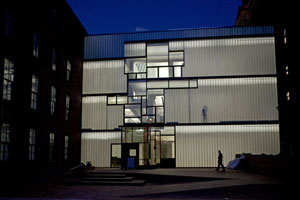 ter, was the substitute of the one side that used scattered fenestration on the Cornell building with a series of Reidfeldesqe metal windows at pratt. The most intriguing part of this move, in my mind, is that the Cornell building was given windows and creases on one elevation that were based on the coordinates of a random number generator. At the time this was something that I found absolutely fascinating. How does one justify such a complete distrust of their own academically trained design eye to hand over a whole facade to a module of java 2.1?
At Cornell at the time, and still, it is widely accepted as something approaching fact that there are only three modules that have any credence. The famous le modular man of Mr Corbusier, the golden ratio, and the peter eisenman nine square grid. You can check out the establishment of the latter in the watershed pamphlet Five Architects, in which such names as Meier, Graves, and Hedjuk use this as the ONLY generative base. Peter is still doing this in new construction even. So, I saw this a widely unpopular strategy, and would have expected the more cardboard designs of Billie Tsen or Thom Mayne to prevail in the closed competition.
Well, if the design was a congressional bill, random numbers would have been the language tacked onto the end extending illegally the Patriot Act. Nobody noticed, and I was angry.
I just want to add at this point that no number generated by a computer is truly random, as everyone knows. Pseudo randomness is fine for purposes of anything that is visual, right?
Well, there are limits, obviously over al large sample area, the eye can begin to sense patterns even where no other stimuli tells us so. This is why we are always using tiled patterns at an angle in our renderings, and asking for "random" interference in our bump maps. Because we believe that the world is more random than he world in the computer, and we are right. I think back to the movie pi, in which Max has found a shortcut to the future of the stock market. The answer is that organic matter contains the tendencies to be introduced to a silicon computer that can be used to replicate the market - a human controlled affair. Far from the butterfly effect, this is indicative of the ability of any living thing to be more and thoroughly random than a computer. Hotbits knows this, and so do many cryptologists. Why don't designers and architects?
Our built world is random, and so is the mind. Computer languages frequently have number generators, but this is only as good as what you seed it with. This is the value of the architect to come and design your house. Otherwise toll brothers would be building everyone's trophy mansion. The qualities of design are far more intangible that the rule based permuations possible from an online floorplan applet. And obviously there is only relevance on a flat site. The flash code still doesn't know what to do on a renovation, or when there is a hill.
To this extend, we are still in the early age of AI software that doesn't' learn, it just reacts and solves problems through brute force.
And I know that we have a long way to go from a coding standpoint. We cant even may a shuffle play on my stereo that doesn't play the same song twice in a row. What hope do our facades have?
IDEA: Test showing actual random colors and pseudorandom colors could show this. I think. I will update with this applet shortly.
Yet another example of the digital analog disparity can be seen by google's location of the prime meridian. Hmmm.
So, a little about randomness and luck. There has always been a close link between architecture and the concept of random placement or location. The earliest that I recall is a now infamous first concept for Milstien hall at Cornell university, a boxy design that fell under the "cube within a cube transforming itself to something else through the use of a fourth dimension" and I use quotes extremely liberally there. Anyway, this design was a 3-4 story box enclosed in structural channel glass (profilit) with stacked critique space at the core. It seemed somewhat unique at the time, until just last week when I noticed the new architecture building at the Pratt Institute done by, you guessed it, the one and only Stephen Holl and Associates. Well, we know what happens to old sketches when they are done with them at this office, they're not shredded. Anyway, the part that changed, aside from the whole thing being a tad shor
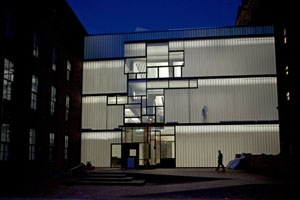 ter, was the substitute of the one side that used scattered fenestration on the Cornell building with a series of Reidfeldesqe metal windows at pratt. The most intriguing part of this move, in my mind, is that the Cornell building was given windows and creases on one elevation that were based on the coordinates of a random number generator. At the time this was something that I found absolutely fascinating. How does one justify such a complete distrust of their own academically trained design eye to hand over a whole facade to a module of java 2.1?
At Cornell at the time, and still, it is widely accepted as something approaching fact that there are only three modules that have any credence. The famous le modular man of Mr Corbusier, the golden ratio, and the peter eisenman nine square grid. You can check out the establishment of the latter in the watershed pamphlet Five Architects, in which such names as Meier, Graves, and Hedjuk use this as the ONLY generative base. Peter is still doing this in new construction even. So, I saw this a widely unpopular strategy, and would have expected the more cardboard designs of Billie Tsen or Thom Mayne to prevail in the closed competition.
Well, if the design was a congressional bill, random numbers would have been the language tacked onto the end extending illegally the Patriot Act. Nobody noticed, and I was angry.
I just want to add at this point that no number generated by a computer is truly random, as everyone knows. Pseudo randomness is fine for purposes of anything that is visual, right?
Well, there are limits, obviously over al large sample area, the eye can begin to sense patterns even where no other stimuli tells us so. This is why we are always using tiled patterns at an angle in our renderings, and asking for "random" interference in our bump maps. Because we believe that the world is more random than he world in the computer, and we are right. I think back to the movie pi, in which Max has found a shortcut to the future of the stock market. The answer is that organic matter contains the tendencies to be introduced to a silicon computer that can be used to replicate the market - a human controlled affair. Far from the butterfly effect, this is indicative of the ability of any living thing to be more and thoroughly random than a computer. Hotbits knows this, and so do many cryptologists. Why don't designers and architects?
Our built world is random, and so is the mind. Computer languages frequently have number generators, but this is only as good as what you seed it with. This is the value of the architect to come and design your house. Otherwise toll brothers would be building everyone's trophy mansion. The qualities of design are far more intangible that the rule based permuations possible from an online floorplan applet. And obviously there is only relevance on a flat site. The flash code still doesn't know what to do on a renovation, or when there is a hill.
To this extend, we are still in the early age of AI software that doesn't' learn, it just reacts and solves problems through brute force.
And I know that we have a long way to go from a coding standpoint. We cant even may a shuffle play on my stereo that doesn't play the same song twice in a row. What hope do our facades have?
IDEA: Test showing actual random colors and pseudorandom colors could show this. I think. I will update with this applet shortly.
Yet another example of the digital analog disparity can be seen by google's location of the prime meridian. Hmmm.
Subscribe to:
Posts (Atom)


